Services / Legacy modernization with AI
Services
Legacy modernization with AI
We use AVATAR CODING, the AI platform we built in-house, to rebuild legacy systems into next-generation strategic assets. Technical debtextra work each change costs after repeated quick fixes, like a loan whose interest grows until repaid holds back a company’s growth. Rather than only replacing systems, we aim to clear that debt itself and build a foundation that stands up to change.
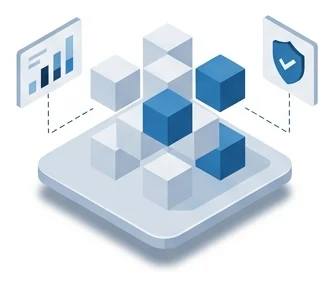
Depending on the state of your existing systems, we modernize applications, redesign systems for the cloud, or do both.
Background
The “2025 digital cliff” is about the backlog, not a deadline
Japan’s Ministry of Economy, Trade and Industry described the “2025 digital cliff” in its report on digital transformation (DX). The term is widely known as a warning about the losses companies face if they keep running aging core systems. In practice, though, the problem is not any particular year. Debt piles up with every round of changes, and at some point it stops new initiatives altogether. That pattern is the real problem.
We don’t recommend clearing this debt all at once. We work through it in order, starting with the parts that affect your business most, while your existing systems keep running. During the first assessment, we design the order and the team setup for this with you. Once you know where to start, modernization becomes a realistic plan.
Sound familiar?
Old systems are blocking your next move
Technical debt piling up
Repeated changes have made the system complex. No one can see inside it, yet maintenance and operating costs keep rising.
Not enough people or knowledge
Fewer engineers can work with VB6, older Java, or ASP.NET, and the people who know the current specifications are disappearing.
Slower development
The system is one monolithic structure, so no one can tell what even a small change will affect. Improvements can’t keep up with the market.
Cloud benefits left unused
The system has moved to the cloud, but its architecture hasn’t changed. It misses what the cloud is good at, such as scalability and automation.
A common problemPress a button below to see each stage
The common problem is an old town merged into one mass, with no district borders or streets. Fix one spot, and you can’t tell what else it affects.
Assessing the system is like surveying the town before redevelopment. We map what each district does and what it connects to.
Redesigning is like drawing up the plan for the new town. We agree with you on how to divide the districts and the order in which to switch them over.
Modernizing in phases rebuilds the town one district at a time while it stays in use. The system keeps running, and districts switch over in the agreed order.
Stabilizing and improving is like patrolling the town once it is built. We check that the new town fits the way it is used, and adjust it when needed.
Key termsAPI gatewayA shared entry point to every service, like the reception desk of a building. It takes requests from outside and passes each one to the right service.Shared data platformThe base that lets several services use the same data.
This is a conceptual diagram.
How we work
One step at a time, not all at once
We work in four stages. We recommend a phased approach that starts with the parts that have the most impact. We set priorities in the first assessment, before any work begins.
You receive deliverables at each stage.
The cards are illustrations of the deliverables, not the actual documents.
-
01 Assess
We start by working out the current state from the running system and its code, then rebuild the specifications and business flows. Even if the people in charge are gone, we make the current system readable again.
- Rebuilding specs and business flows
- Sorting out current problems
- Setting priorities
Deliverable previewAssessment and problem listAreaSpecsFlowsOrderArea A1Area B2Area C3Common4Current system, now readable -
02 Redesign
How far to split the system depends on what you want to scale and how your operations team is set up. We choose the target technology with an eye on who will maintain it after the migration.
- Designing the new architecture
- Choosing the target technology
- Agreeing on switchover scope and order
Deliverable previewNew architecture designThe split is decidedArea AArea BArea CCommonHow far to splitWho maintains itSwitchover order -
03 Modernize in phases
We switch to the new architecture in order, starting with the parts that have the most impact, while your existing system keeps running. We plan for both systems to run in parallelleaving the old system on for a while after launch, so work is less likely to stop during the migration. Engineers review the AI’s converted code before it goes in.
- Converting and cleaning up code with AI
- Review by engineers
- Generating tests and checking behavior
Deliverable previewModernization roadmapArea AArea BArea CCommonOldParallel runNewSwitch over in order -
04 Stabilize and improve
We don’t stop at modernization. We design how the system runs after the migration. Test generation and continuous monitoring keep quality up, and we put safeguards in place so debt doesn’t build up again.
- Designing operations after migration
- Continuous monitoring
- Safeguards against new debt
Deliverable previewDesigning operations after migrationTest generationRunningContinuous monitoringRunningSafeguards against new debtRunningQuality, kept high
What we offer
We design the order instead of rebuilding from scratch
The service has three pillars. You can choose application modernization or cloud redesign on its own, or both together, depending on your situation. The third pillar, AVATAR CODING, is the platform we use to carry out the other two.
- 01Application modernizationLegacy to a modern environmentMake the specs readable firstDesign the migration order
- 02Cloud modernizationModernize without losing valueSplit into independent unitsRelease changes safely
- 03AI-driven approach with AVATAR CODINGOur own platformDefine AI and human rolesThe base for the other two
01 Application modernization
Turn unreadable systems back into “living knowledge”
We move systems written in VB6, older Java, or ASP.NET to a modern environment that stands up to maintenance and extension. The core of the work is not the rewrite itself. It is recovering what runs today and how it works. Only once the specs are readable again can you judge the migration order and the risks.
Language and platform migration
We migrate from VB6, older Java, ASP.NET, and similar technologies to current ones such as Go, Kotlin, TypeScript, and Modern Java. When we choose, we also consider who will maintain the system after the migration.
Making existing systems visible
We rebuild specifications and business flows from code that has no documentation left. Even if the people in charge are gone, we start by making the current system readable again.
AI refactoringreorganizing the inside of a program so it is easier to read, without changing what it does
AI converts and cleans up the code, so it becomes readable and maintainable again. Engineers always review the converted code before it goes in.
A monolithic structure is like one big building where the walls of every room are joined. If you fix one spot, you can’t tell what else it will affect.
A loosely coupled design is like giving each room its own building. Each one can be modified on its own.
We don’t split everything out at once. We go in order, starting with the parts that have the most impact. During the migration, we plan for the new system to run in parallel with your existing one.
02 Cloud modernization
Beyond the move: going after the cloud’s benefits
We keep the value of your existing systems and rebuild them on an architecture that makes use of what the cloud does well. The move itself is not the goal. Moving to the cloud pays off only when operations take less effort, capacity can grow when needed, and changes can be released safely.
Moving to microservicesa way of building software that splits one large system into small systems by role, each running on its own
We redesign the monolithic structure as units that run independently. How far to split it depends on what you want to scale and how your operations team is set up.
Container platformspackaging an app with all it needs into one box, so it is easier to run the same way elsewhere and IaCinfrastructure as code: setting up servers and other resources from configuration files, not by hand, so you can rebuild the same environment again and again
We use Kubernetes, Terraform, and similar tools to automate environment setup on AWS or Google Cloud. Because the configuration is kept as code, the same environment can be recreated any number of times.
CI/CDcontinuous integration and continuous delivery: a setup that automatically tests changes to the source code and carries them through to release pipelines
We set up the flow from testing to release, so changes can go out in small, safe steps. This cuts the manual checks that used to come with every release.
Do you only need a new cloud environment, or operations and optimization for one you already have? We also offer that through AWS and GCP cloud implementation.
03 AI-driven approach
Roles for AI and engineers, set in advance
AVATAR CODING is a platform we built in-house to support collaboration between AI and engineers. Instead of deciding each time what AI handles and what people decide, we set this in advance as part of the system. AVATAR CODING is the foundation for it.
- STEP 01Code analysisRead the existing system
- STEP 02Spec rebuildMap business flows
- STEP 03Code conversionRewrite in current technology
- STEP 04Tests and validationCheck behavior and quality
AI harness layerThe underlying setup that defines in advance what AI handles and the steps it follows.
Knowledge Hub
It collects design information and know-how from development and shares it in a form that can be reused. The current specifications we analyze are kept here too.
AI Package & Agents
Several AI agents, each with a different role, analyze code and existing designs, and generate documents.
Quality & Drift Control
Test generation and continuous monitoring keep quality up and stop debt from building up again.
AVATAR CODING is the platform behind our own development work. You don’t need to install it on your side.
Strengths
Why clients work with NAL
Built on our own AI platform
AI and engineers split the roles and work together on code analysis, rebuilding specifications, refactoring, and quality control. We don’t piece together outside tools. We built this platform and use it ourselves, so we can adapt it for each project.
Run the way Japanese clients work
A lead who understands Japanese business practices and quality standards drives the project. How we reach agreement, how detailed our reports are, and how acceptance checks run are all designed around the way Japanese clients work.
AI-driven development (AIDD) in practice
We practice this approach in-house: AI is built into the whole development process, not used as a one-off tool.
Applications and cloud, end to end
You can ask us for applications, for the cloud, or for both together.
What you can expect
What changes after modernization?
Better IT cost structure
You can review the budget that was tied up in maintenance and operations, and it becomes easier to invest in new business and DX.
Faster releases
AI and cloud automation shorten the development cycle, so you can release the features you need when you need them.
No more black boxes
Once the system is readable again, it no longer depends on a few people. Even when the people in charge change, others can still work on it.
Ready for future change
With a modern architecture, you can change the setup to handle more users and data, or a shift in business direction.
The figures show the idea only. They are not actual data.
Technologies
What we’ve worked with
 Terraform


These are typical examples. If your environment isn’t listed, start by telling us about your current setup.
Frequently asked questions
Questions clients often ask before contacting us
No. We recommend a phased approach that starts with the parts that have the most impact. We set priorities in the first assessment, before any work begins.
Yes. We start by working out the current state from the running system and its code, then rebuild the specifications and business flows.
We plan for the old and new systems to run in parallel. We agree with you on the scope and order of the switchover before the work starts.
Engineers review the converted code before it goes in. We also generate tests and check, as we go, that the system behaves the same before and after the migration.